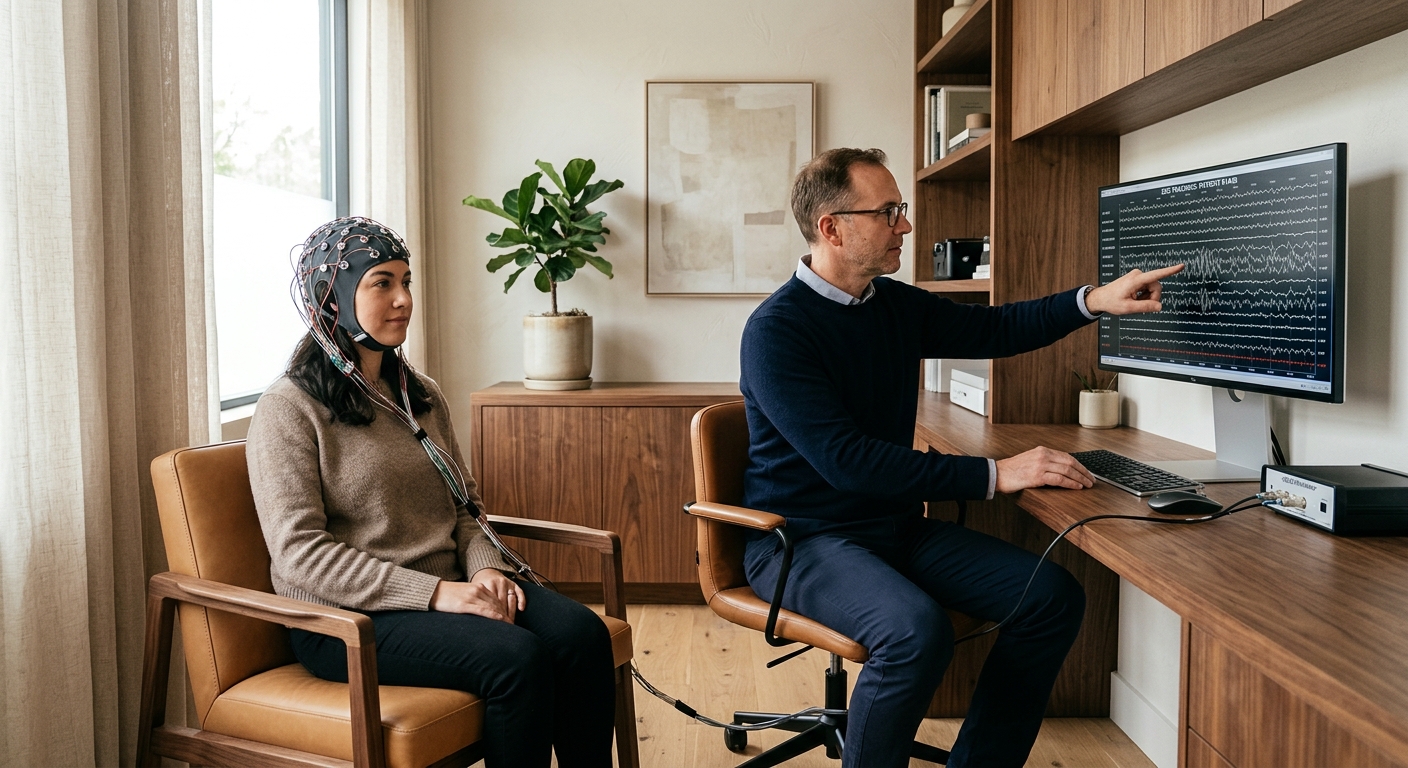
In Office Neuro Assessment
The Full Picture of Your Nervous System
Most people who arrive here have already done some version of looking for answers. They have had labs drawn, seen specialists, tried interventions that helped partially or not at all. What they have rarely had is a single session where every relevant system is measured together, interpreted together, and explained in plain language by someone who can connect the dots across all of it.
That is what this assessment is.
It is not a screening. It is not a checklist. It is a comprehensive measurement of how your nervous system is actually functioning - brain activity, balance and orientation, sensory communication, autonomic regulation, attention and cognition - taken in one visit, interpreted as a whole, and given back to you in writing with a clear recommendation attached.
Why These Measurements Together
Each system we measure tells us something the others cannot. Your qEEG shows us patterns of electrical activity in your brain and compares them against a normative database matched to your age range. That tells us something. But it tells us more when we can also see how much energy your system is spending just to stay oriented in space, or how much processing load is being created by a sensory communication breakdown that has never been identified before.
Balance, vestibular function, proprioception, and oculomotor tracking are not separate from cognition or regulation - they feed directly into both. When orientation is costing your nervous system a significant amount of resources, there is less available for everything else. That shows up in attention, in mood, in fatigue, in the feeling that you are working harder than you should be just to get through an ordinary day.
Sensory processing is where we look at how well your sensory systems and your brain are communicating with each other. When that communication is breaking down, the nervous system is not receiving accurate information about the world or the body. That is not a behavioral problem. That is a signal problem - and it shapes everything downstream.
Clinical grade heart rate variability gives us a different window into your autonomic nervous system than the metric on a wearable device. The measurement process matters, and the interpretation matters more. What we are reading here is the actual flexibility of your nervous system - its capacity to shift states in response to demand, which is one of the most useful things we can know.
Attention and cognitive performance measures add another layer, showing us not just whether you are struggling but where in the processing chain things are breaking down.
Your History Is Part of the Picture
The measurements tell us what is happening in the nervous system right now. Your history tells us what the system has been asked to carry. Both matter. A structured history is part of every comprehensive assessment because nervous system patterns do not appear from nowhere - they are adaptive responses to real circumstances, and understanding those circumstances helps us interpret the data accurately and make better recommendations.
What You Leave With
At the end of the process you will have a written individualized report - not a generic summary, but a document built from your specific data - and a review session where we walk through it together. We explain what we found, what we think it means, and what we think should happen next.
That recommendation will be honest. If the answer is a programme we offer, we will tell you which one and why. If the answer is someone else - a different provider, a different modality, a referral we think you need - we will tell you that too. The goal of this assessment is not to sell you a next step. The goal is to give you an accurate picture and a clear direction.
For Children and Families
The same comprehensive process is used for children from age seven. The measurements are identical. The pacing is adjusted to the child, meaning we move at a speed that works for them and allows us to get accurate data without pushing the system into a state that compromises the results. For many families, this assessment is the first time someone has looked at all of these systems together in their child and explained what they are seeing in a way that actually makes sense of what they have been living with.
Practical Details
Plan for approximately two hours at our Waynesville office. The recording process for the qEEG is painless and non-invasive. You do not need to prepare in any special way beyond arriving rested if possible. The review session is scheduled separately so you have time to process the information and come with questions.
If you are not sure whether this is the right starting point for you or your child, that is a reasonable question and one we are glad to talk through before you book.
- Assessment